

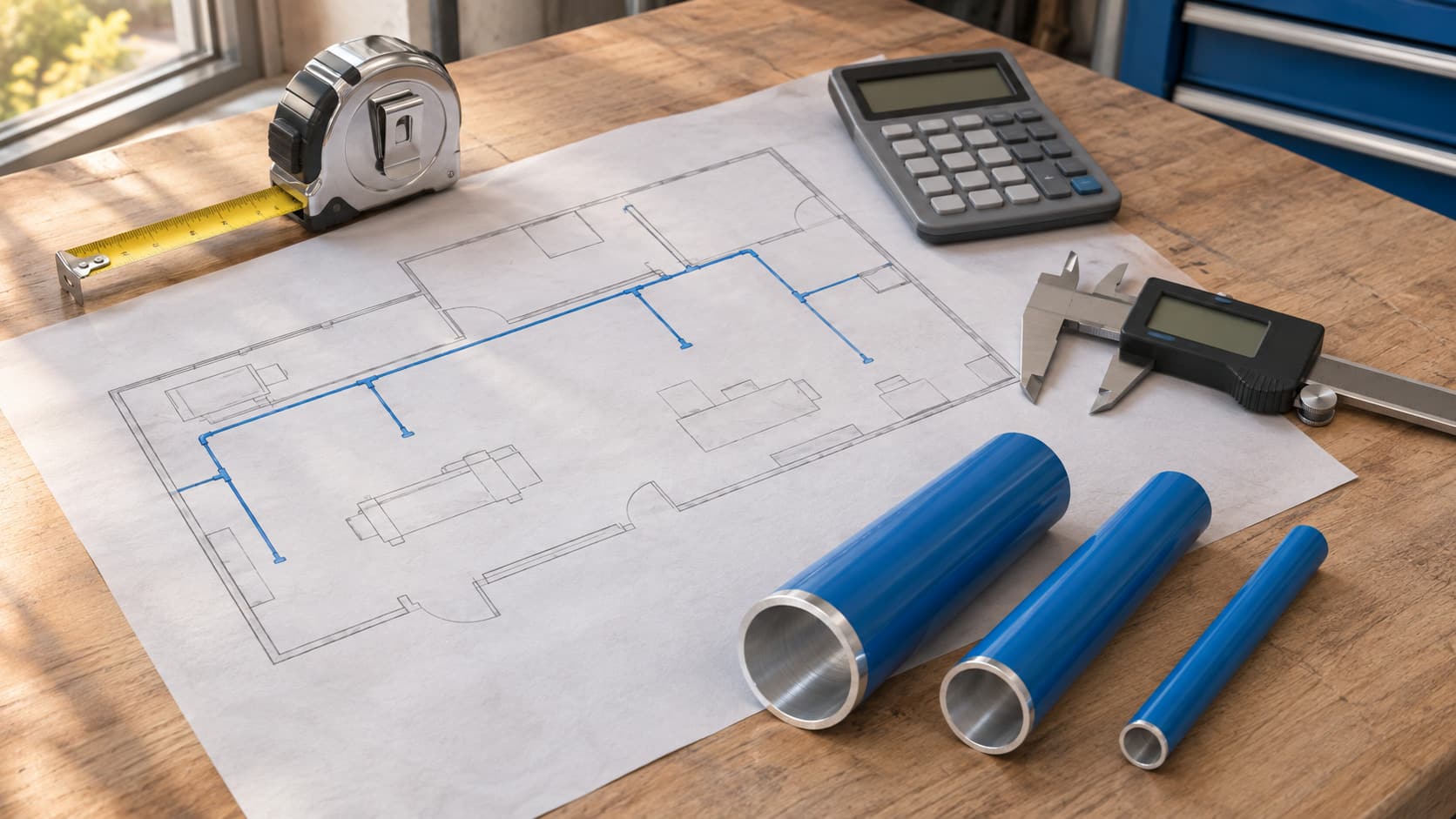
The right compressed air pipe size depends on airflow demand, operating pressure, piping distance, system layout, and acceptable pressure loss. There is no single diameter that works for every garage, automotive shop, or manufacturing facility. A pipe that supplies one occasional-use tool may be too restrictive for several machines operating simultaneously.
At Aluminum Air Pipe, we help customers make this decision with confidence. Understanding a few practical sizing principles can help you plan a system that delivers air where you need it and accommodates realistic growth.
How do I determine what size compressed air pipe I need?
Start with the airflow requirements of the equipment your piping will supply. Then consider the pressure those tools need while operating, the distance from the air source to each outlet, and the restrictions along the route. These details allow a sizing calculation or manufacturer’s sizing tool to evaluate suitable diameters.
The goal is to deliver the required airflow without excessive pressure loss. Your compressor’s capacity matters, but so does how air moves through the distribution network. Choosing pipe by appearance, building size, or a neighbor’s installation can lead to disappointing results.
What do CFM and PSI mean when sizing air pipe?
CFM stands for cubic feet per minute and describes airflow. PSI stands for pounds per square inch and describes pressure. Your tools need both an adequate quantity of air and enough pressure at their connections to operate correctly.
Check how airflow figures are stated before comparing specifications. SCFM and ACFM describe volume under different reference conditions and should not be treated as interchangeable. A sizing chart should explain its airflow basis, operating pressure, and other assumptions so the information entered matches the calculation.
Should I add together the airflow requirements of every tool?
Consider which tools or machines are likely to operate simultaneously. Adding every connected tool’s maximum demand may overstate normal requirements, while sizing around average consumption alone can overlook important peak demand.
For example, a garage with one person switching between tools differs from an auto shop where several technicians work at once. Equipment with continuous demand also differs from tools used in short bursts. Use realistic operating patterns, and confirm whether a tool’s published consumption represents continuous operation or an assumed duty cycle.
Can I match the pipe size to my compressor outlet?
The compressor outlet size does not automatically determine the correct diameter for your main distribution line. That connection serves the compressor’s discharge arrangement, while the distribution system may need to carry air over considerable distances and supply multiple branches.
A larger distribution main may be appropriate even when the compressor has a smaller connection. Follow the compressor manufacturer’s requirements for the immediate discharge piping and connection, including temperature and vibration considerations, then size the downstream network for its actual duty.
How does pipe length affect compressed air pipe sizing?
Longer pipe runs generally create more friction loss at a given airflow and diameter. A size that works over a short route may cause excessive pressure loss when the same demand is supplied much farther away.
Measure the actual proposed route, including vertical sections and branches. Fittings and valves also introduce resistance, which must be accounted for using suitable calculation methods or manufacturer data. The straight-line distance across the building rarely tells the whole story.
What happens if compressed air pipe is too small?
Undersized piping can restrict airflow and reduce pressure at equipment during operation. A system may show satisfactory pressure when tools are idle, then experience a substantial drop when demand increases.
Compressed Air Challenge’s guidance on compressed air distribution and pressure drop explains how flow restrictions can appear as low-pressure problems. It also highlights restrictions near the equipment, so the main pipe should not be blamed before hoses, couplers, filters, and regulators are evaluated.
Do the main line and individual drops need to be the same size?
Not necessarily. A main line may carry the combined demand of several workstations, while an individual branch supplies only one machine or a smaller group of tools. Each section should be sized around the airflow passing through it and its allowable pressure loss.
Branch connections such as Quick Drops help distribute air from a header to work areas. Select their connection sizes alongside the branch piping and downstream components. A generously sized main cannot overcome an overly restrictive outlet connection.
Does a loop system let me use smaller pipe?
A properly designed loop can provide multiple paths for air to reach an outlet, potentially reducing distribution pressure loss compared with a similar single-path layout. However, it does not automatically justify selecting a smaller diameter.
The benefit depends on the location of the supply, outlet demand, pipe lengths, and how flow divides around the loop. Evaluate the network as a whole rather than applying a blanket reduction in size.
Does aluminum pipe need to be sized differently from steel pipe?
Use the dimensions and performance data for the specific piping system you are considering. Different materials and product families can have different internal diameters, wall thicknesses, and fitting restrictions, even when their advertised sizes appear similar.
Aluminum Air Pipe offers AIRnet compressed air pipe in multiple diameters, with corrosion-resistant aluminum and an additional protective coating inside and outside. Its available sizes provide options for different distribution demands, but the correct choice still requires a sizing review.
Should I choose a larger pipe for future expansion?
Include anticipated equipment additions when evaluating your main line. Planning for realistic growth can help avoid replacing substantial sections of piping later.
Compressed Air Challenge recommends accounting for future expansion because additional airflow can increase pressure losses throughout an existing network. Compare suitable size options against both present demand and credible future requirements, rather than choosing the largest pipe available without a reason.
What information should I provide for a pipe sizing recommendation?
Provide a dimensional layout showing the compressor location, proposed pipe routes, and equipment connections. Include compressor output at the intended pressure, equipment airflow requirements, simultaneous-use expectations, and the minimum pressure needed at critical outlets.
Also describe existing dryers, filters, hoses, and other components along the air path. If you are troubleshooting an installed system, pressure readings taken during representative demand can help distinguish distribution restrictions from inadequate supply.
Can Aluminum Air Pipe help me choose the right diameter?
Yes. Aluminum Air Pipe offers free pipe sizing, design services, and bill of material creation to help customers plan their distribution projects. Whether you are supplying a home garage or expanding an industrial facility, sharing your layout and operating requirements gives our team a useful starting point.
The right compressed air pipe size supports dependable equipment operation without unnecessary guesswork. Contact Aluminum Air Pipe to discuss your project and develop a practical system around the way you work.