
Fueling Your Automotive Shop with Clean, Reliable, and Powerful Air
In a modern automotive workshop, compressed air is as essential as a wrench or a lift. It drives impact guns, powers sanders, operates lifts, and delivers the flawless finish on a custom paint job. But not all air systems are created equal. An old, leaky, or undersized system can lead to frustration, poor results, and lost productivity. Today, we’re answering questions specific to auto body and mechanical shops looking to build an air system that performs as well as the vehicles they service.
Why is air quality so incredibly important for automotive painting?
For any painter, a perfect finish is the ultimate goal, and contaminated compressed air is the number one enemy of that goal. The two biggest culprits are water and oil. When moisture in the air line hits a freshly painted surface, it can cause small, crater-like defects known as “fisheyes.” Oil vapor, often from the compressor itself, can cause similar issues and prevent paint from adhering properly. Traditional steel pipes compound this problem by adding rust and scale into the mix. This is why a multi-stage approach is critical. It starts with a corrosion-free aluminum air pipe system that won’t introduce contaminants, followed by point-of-use filtration. Using a dedicated FRL unit with a coalescing filter right before the spray gun is the professional’s way to guarantee that only pristine, dry air reaches the nozzle, a practice advocated by automotive finishing experts at publications like BodyShop Business.
My shop runs high-demand tools like 1-inch impact guns and DA sanders. Can an aluminum system keep up?
This is a fantastic question that gets to the heart of system design. High-consumption tools require both high pressure (PSI) and, more importantly, high volume (CFM). An undersized pipe system will starve these tools, causing them to feel weak and perform poorly. This is where proper sizing and layout are crucial. For a busy auto shop, we typically recommend a 1-inch or larger main line to ensure minimal pressure drop. Furthermore, designing the system as a “loop” that circles the shop is the ultimate solution. A looped system allows air to flow from two directions to any tool, dramatically increasing available volume and ensuring that one mechanic using an impact wrench doesn’t cause the painter’s air pressure to fluctuate. An aluminum system is perfectly suited for this, delivering the massive, stable volume of air your high-demand tools need to perform at their peak.
What’s the best way to set up multiple bays for efficiency?
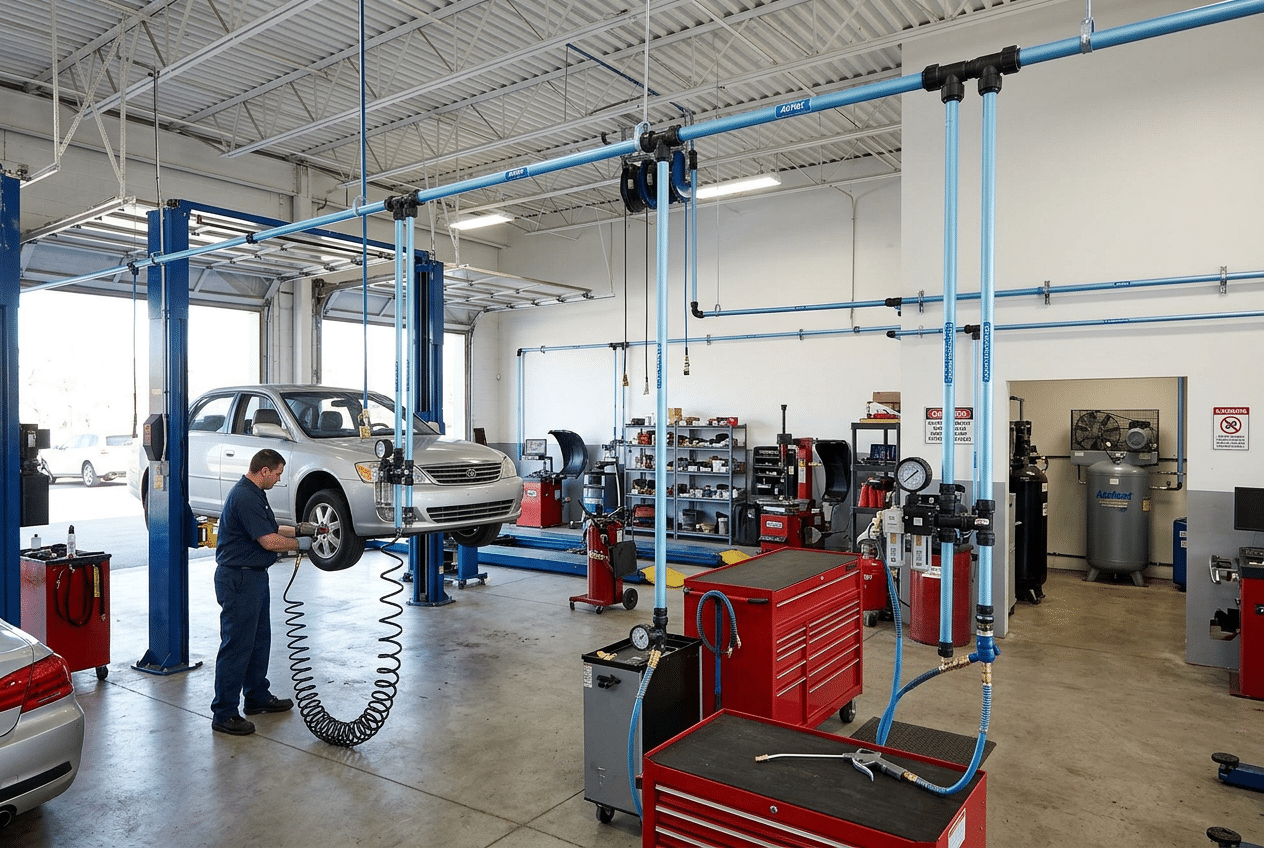
An efficient shop layout requires convenient access to air in every bay. The days of dragging long, heavy hoses across the shop floor should be over, as they are both a trip hazard and highly inefficient. The ideal setup involves creating dedicated, professional workstations in each bay. This can be achieved by running drops from your overhead main line down the walls or columns. At the end of each drop, a wall-mounted outlet block or a manifold provides multiple connection points. For ultimate convenience, integrating a high-quality hose reel into each bay keeps hoses off the floor, protected from damage, and ready for immediate use. This modular approach allows you to create a clean, organized, and highly productive environment.
How does an aluminum system help with changing shop needs and expansions?
The automotive industry is always evolving, and your shop may need to adapt. You might add a new bay, a new lift, or a dedicated detailing area. This is where the modularity of an aluminum air pipe system truly shines. With a traditional threaded steel system, adding a new line is a major project involving cutting, threading, and significant downtime. With our push-to-connect system, expanding your network is simple. You can safely depressurize a section of the line, use a simple tool to disassemble a joint, insert a new tee fitting, and run your new line. The process is quick, clean, and can often be done in a fraction of the time, minimizing disruption to your business.