
There’s a certain comfort in the familiar. If you’ve been running the same black iron piping in your shop for a decade or more, the idea of tearing it out and starting fresh can feel overwhelming. Yet many facility managers and shop owners reach a tipping point—usually after chasing one too many leaks or watching their energy bill climb without explanation—where they realize their aging pipework has become a liability rather than an asset. At Aluminum Air Pipe, we talk with people at this crossroads every day. Here are the questions they ask most often, along with honest answers to help you decide whether an upgrade makes sense for you.
How do I know it’s actually time to replace my old piping?
Your system usually tells you before you’re ready to listen. The most obvious warning sign is the sound of hissing during a quiet moment when nothing is running—that’s your money escaping into the atmosphere. Other clues are subtler. If you find yourself cranking up the compressor’s discharge pressure to get adequate performance at your farthest workstation, you’re compensating for pressure drop caused by internal corrosion. If you’re regularly blowing rust particles out of your air tools or finding orange-tinged water in your filter bowls, your pipe walls are actively deteriorating. Perhaps the most telling sign is when your compressor cycles on frequently over a weekend when the shop is empty. That means leaks are bleeding your system dry. A simple way to assess your situation is to conduct a basic compressed air audit, measuring how long your compressor runs when no equipment is in use. The results are often eye-opening.
Do I have to replace my entire system at once, or can I upgrade in stages?
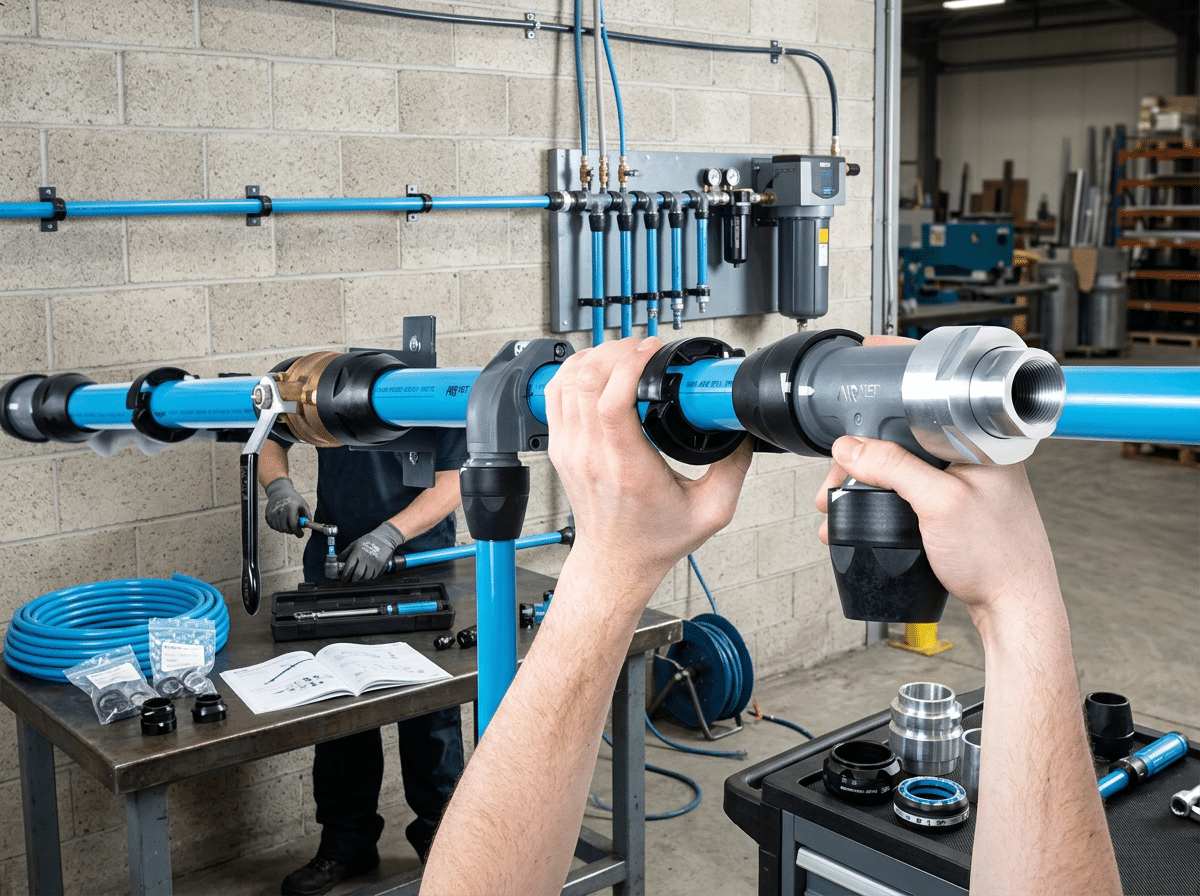
This is one of our favorite questions to answer, because the flexibility here surprises people. You absolutely can phase your upgrade. Many of our customers begin by replacing their main header line—the section that carries the highest volume and typically causes the most significant pressure drop—while leaving existing drop lines temporarily in place. Others start with a single problem area, like a corroded section feeding a paint booth or an assembly cell where air quality matters most. Because our system uses standardized components and transition fittings, connecting new aluminum pipe to existing threaded steel is straightforward. You can improve your worst-performing zones immediately, spread the investment across multiple budget cycles, and expand the aluminum network as time and resources allow. Our full catalog of aluminum piping and components is designed to work together seamlessly, so a system built in phases performs just as well as one installed all at once.
What size pipe do I actually need? I’m worried about getting it wrong.
Undersizing is one of the most common and costly mistakes in compressed air system design, and it’s an understandable one—smaller pipe costs less upfront, so it looks like a savings. In reality, undersized piping restricts flow and creates friction losses that your compressor must overcome by working harder, forever. The right size depends on three factors: your total air demand in cubic feet per minute, the total length of your piping run including equivalent length added by elbows and tees, and the maximum pressure drop you’re willing to accept, ideally under two or three PSI across the whole system. As a general principle, it’s far better to go one size up than one size down. The incremental material cost of larger pipe is trivial compared to years of elevated energy consumption. If you’re uncertain, reach out to us with your compressor specifications and a rough sketch of your layout—we’re happy to help you get it right the first time.
What kind of maintenance does an aluminum system require?
Refreshingly little, and that’s precisely the point. Because aluminum doesn’t rust, the interior surface stays smooth and clean throughout the system’s life, meaning performance doesn’t degrade over time the way it does with steel. Your maintenance routine becomes simple and predictable: drain your moisture separators and check your filter elements on a regular schedule, periodically inspect your filters and regulators to ensure they’re delivering the air quality your equipment needs, and give your connection points an occasional visual check. Beyond that, there’s no scale to flush, no threaded joints to re-seal, and no corrosion to monitor. Establishing a light preventive maintenance routine around your compressor and treatment equipment will keep the whole system running beautifully for decades.
Is the investment really worth it?
For most operations, the honest answer is yes—and the payback period is usually shorter than people expect. When you combine eliminated leak losses, reduced pressure drop, lower compressor run time, extended tool life from cleaner air, and dramatically reduced installation labor, the numbers add up quickly. But there’s also a benefit that doesn’t appear on a spreadsheet: the confidence of knowing your air system simply works, day after day, without demanding your attention.
If you’re standing at that crossroads, we’d be glad to help you take the next step.