

Your compressor’s CFM and PSI help determine how much air your piping must carry and the pressure at which it travels. CFM describes airflow, while PSI describes pressure. Together with pipe length, layout, and equipment demand, these figures help establish the diameter needed to deliver air without excessive pressure loss.
For many customers, the confusing part is understanding how those numbers work together. A compressor might have an impressive maximum pressure rating, yet tools can still struggle when the distribution system restricts airflow. At Aluminum Air Pipe, we help customers connect compressor specifications with the practical requirements of their garages, shops, and manufacturing facilities.
What is the difference between CFM and PSI?
CFM stands for cubic feet per minute and measures volumetric airflow. PSI stands for pounds per square inch and measures pressure. A pneumatic tool needs enough airflow to perform its work while maintaining the required pressure at its inlet.
For example, a tool specified to consume 20 SCFM at 90 PSIG needs that airflow while receiving approximately that operating pressure. A pressure gauge reading of 90 PSI while the tool is idle does not confirm that the system can maintain adequate flow and pressure when the tool runs.
How does CFM affect compressed air pipe size?
Higher airflow generally requires a larger pipe diameter when operating pressure, route length, and allowable pressure loss remain the same. Trying to move more air through the same pipe increases velocity and friction losses.
This is why adding another workstation can affect equipment that previously operated well. The main line may now carry greater simultaneous demand, even though the compressor settings have not changed. Pipe sizing should reflect the airflow expected through each section during representative peak operation.
How does PSI affect compressed air pipe sizing?
Operating pressure affects air density. For the same airflow expressed at standard conditions and approximately the same temperature, air occupies less volume inside a higher-pressure line. This changes its velocity and the resulting pressure loss through a given diameter.
However, higher pressure should not be treated as a shortcut to smaller piping. Size the system around the intended operating pressure and the minimum pressure available during normal operation. The compressor’s maximum PSI rating may be substantially higher than the pressure actually maintained in the distribution main.
Should I use my compressor’s maximum PSI when reading a sizing chart?
Use the pressure specified by the chart’s instructions and representative of the section being evaluated. For a distribution main, this usually means the available operating pressure under demand, with appropriate allowance for normal pressure fluctuations.
Also distinguish gauge pressure from absolute pressure. PSIG measures pressure relative to the surrounding atmosphere, while PSIA includes atmospheric pressure. Gas-flow calculations may require absolute pressure, so entering a gauge reading into an absolute-pressure field can produce an incorrect result.
Are CFM, SCFM, and ACFM interchangeable?
No. A CFM figure needs a stated reference basis to be useful. SCFM expresses airflow at defined standard conditions. ACFM expresses volume at specified actual conditions, which may refer to compressor inlet conditions or conditions elsewhere in a system.
The Compressed Air and Gas Institute’s compressed air system design handbook discusses how pressure, temperature, and reference conditions affect airflow comparisons. Check the definitions on the compressor data sheet and sizing chart before combining their figures. A compressor’s advertised airflow should not automatically be interpreted as the actual volume moving through a pressurized distribution pipe.
Should I size the pipe for compressor output or tool demand?
Consider both. Compressor output helps establish the available supply, while equipment demand shows what the distribution system must deliver. A main serving multiple workstations needs to accommodate their realistic combined demand; individual branches need to accommodate the equipment they supply.
Suppose two machines each require 20 SCFM and regularly operate together. Their shared supply section must be evaluated for approximately 40 SCFM, plus other applicable demand. If the compressor cannot sustain that consumption, increasing pipe diameter alone will not resolve the supply shortage.
Does a larger pipe increase my compressor’s CFM?
No. A larger pipe does not increase the compressor’s production capacity. It can reduce distribution restrictions, allowing more of the available supply pressure to reach equipment during operation.
Aluminum Air Pipe offers AIRnet compressed air pipe in multiple diameters, making it possible to select a system around different airflow requirements. Its corrosion-resistant aluminum construction and protective coating are useful material features, but the diameter still needs to be selected for the application.
Why do tools lose pressure even when the compressor gauge looks normal?
Pressure can drop as air passes through piping, fittings, treatment equipment, hoses, and couplers. Restrictions may become noticeable only when equipment draws air, so an idle gauge reading can conceal a delivery problem.
Compressed Air Challenge’s guidance on distribution piping and pressure drop explains that low pressure can result from flow restrictions, including components close to the machine. Compare pressures during representative operation before deciding whether the problem is compressor capacity, main-line sizing, or a restricted connection.
Do manifolds and outlet connections affect sizing?
Yes. The complete air path needs enough flow capacity. A properly sized main can still feed an undersized branch, restrictive regulator, or small quick-connect fitting.
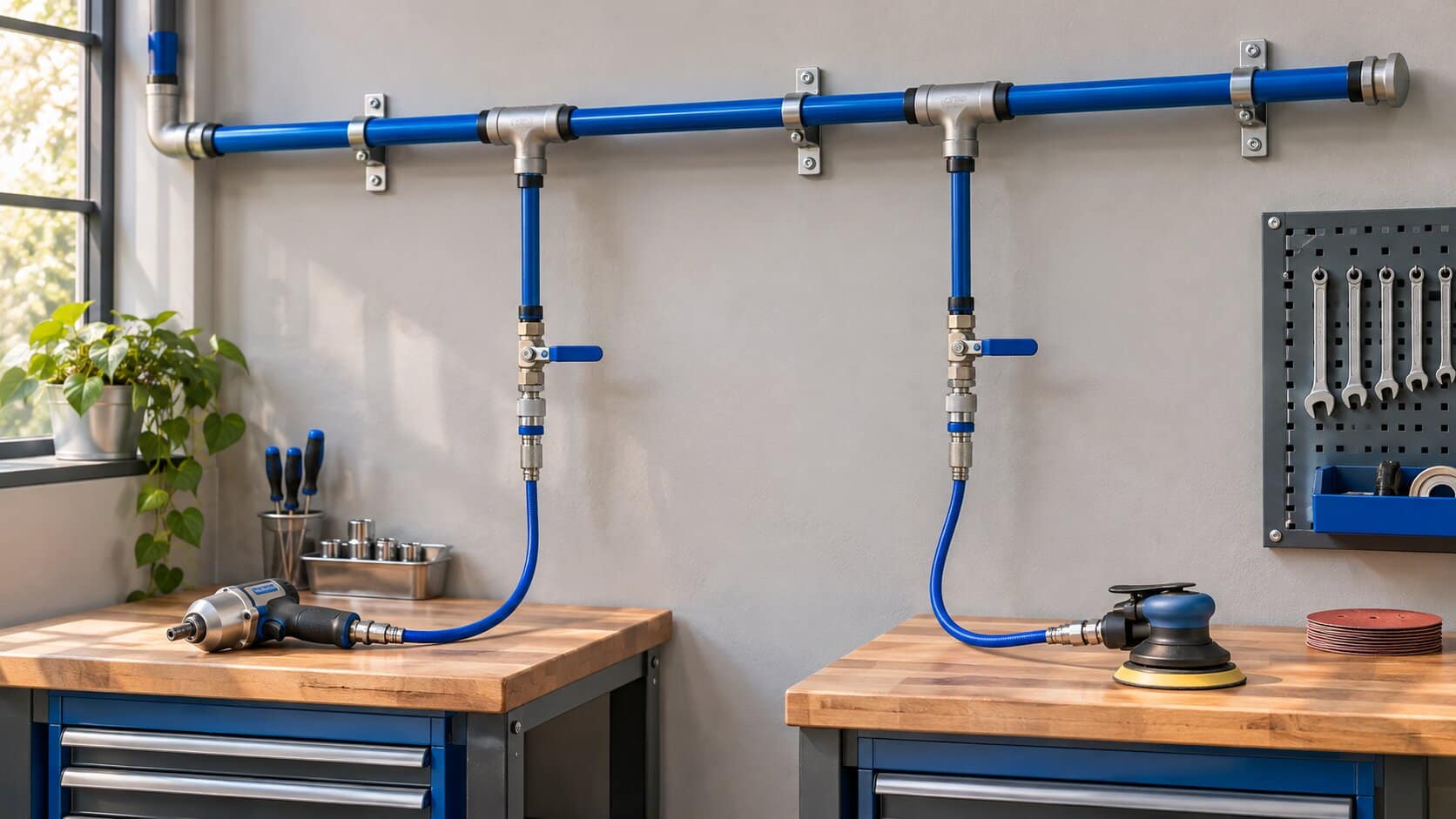
A wall-mounted air manifold can organize connections at a workstation, but its inlet and outlets must be selected around the demand they serve. Adding connection points does not increase the capacity of the upstream piping or compressor.
How do pipe length and future expansion affect the calculation?
Longer routes introduce more friction loss, while fittings add resistance along the way. Two facilities with identical compressors can therefore require different pipe diameters because their layouts differ.
Include credible future equipment additions when evaluating the main. Planning for growth can help avoid excessive pressure loss after expansion, but selecting a larger diameter should follow a sizing review rather than a general assumption that bigger is always necessary.
What information should I provide to Aluminum Air Pipe?
Share your compressor’s airflow rating at the intended pressure, the reference conditions for that rating, and your normal operating pressure range. Include a dimensional layout, equipment airflow requirements, simultaneous-use expectations, and the minimum pressure needed at critical outlets.
Aluminum Air Pipe offers free pipe sizing, design services, and bill of material creation to help customers plan their systems. With the right compressor information and a clear understanding of demand, our team can help you select piping that supports dependable air delivery throughout your workspace.